Sunday, October 23, 2016


WHY IS THERE WATER IN YOUR MASK?

And other open water skills misconceptions.

 Are you one those of those divers who always seems to have water in your mask? After 21 years as an instructor, dive guide, dive boat captain and former dive shop owner, I frequently see divers clearing their mask incorrectly. This isn’t the only mistake I see divers make because they misunderstood either the mechanics or purpose of skills they were taught in open water class. In this and the next blog I will debunk some of these mysteries. Focusing on mask clearing today.
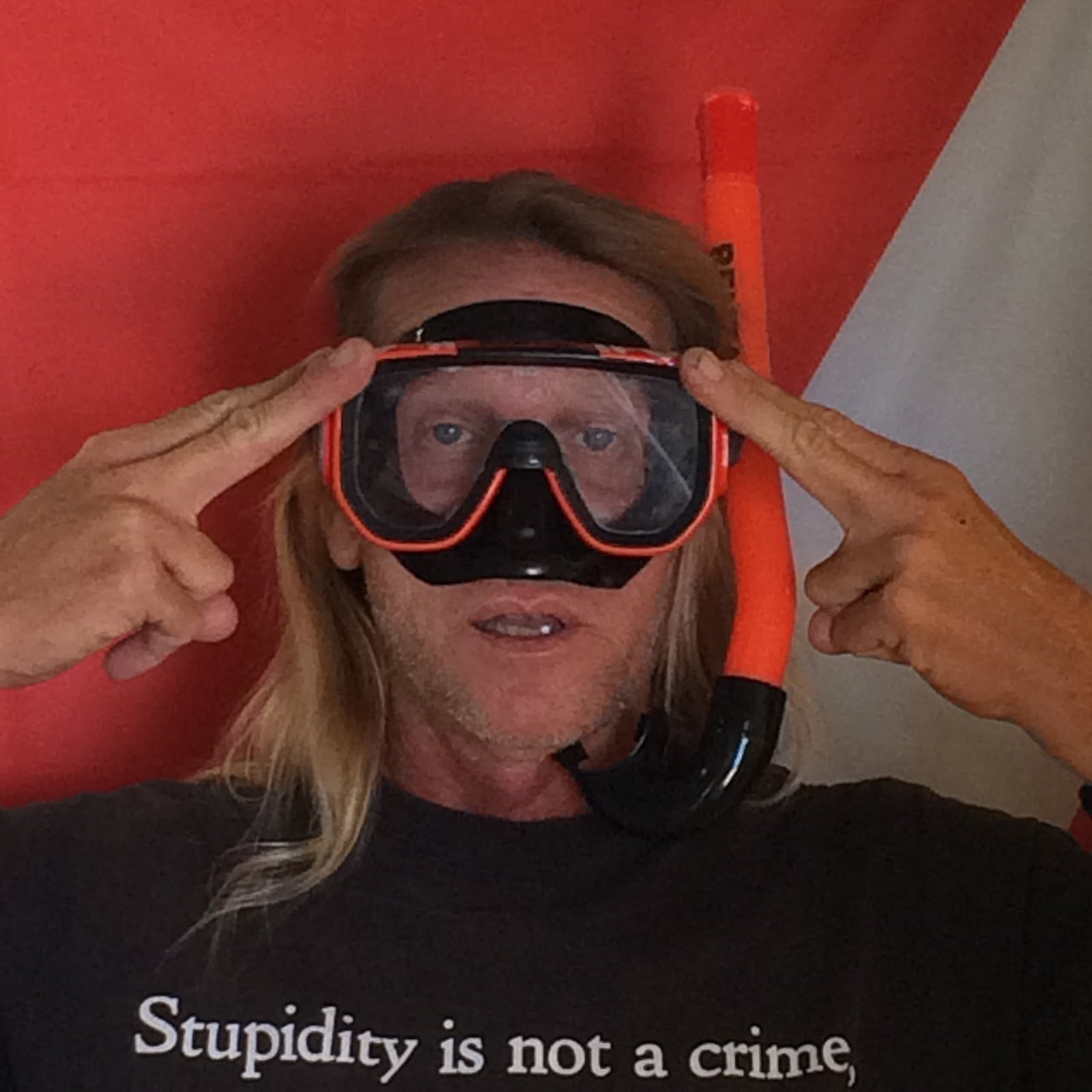
When we are taught to clear our masks in open water class, the instructor often teaches us to “pull gently at the bottom of the mask to break the seal.” Unfortunately, many students graduate with the understanding that they must pull the bottom of their masks away from their face. While it does help get most of the water out of your mask I guarantee that there will still be some left. YOU DO NOT NEED TO PULL THE MASK AWAY FROM YOUR FACE. This usually results in water being sucked back in when you reseal it against your face because divers stop blowing air before they let the mask back into place. Most of the time you can get rid of the water without using your thumbs at all. Take one or two fingers of each hand and place them firmly on the top of each lens or the top of the frame. Next, push the mask firmly against your forehead. Not up but straight back. Then start blowing air out your nose like you are trying to get rid of that big snot wad. (You wouldn’t believe the disgusting things instructors see swimming around in your masks when it is done correctly and you are congested.) But that is ok and part of our job. Don’t be embarrassed by it. Next, tilt your head back and change your position so that you are looking towards the heavens. This allows all the water to settle in the bottom of the mask and be forced out when you are blowing. A diver who is swimming along in a nice horizontal posture will not get all of the water out of his mask until he gets himself in a more upright position allowing the air between the skirt and his skin to become the lowest point. Finally, in rare occasions, use your thumbs to break the seal and not pull the mask away from your face. Try it and see how easy it really is.

There are some other reasons that will cause your mask to have water in it. Facial hair is common. Putting a little silicone grease on your moustache generally helps with this. You could also try shaving a small area right below your nose to provide a smooth surface for your mask to seal against. Funny enough, the guy on the boat with the shortest hair is usually the one with some stuck between his mask and his face. I have long hair and an extra two seconds to insure none of it is in your mask will avoid a lot of frustration during your dive.

All faces are different shapes. For example, divers usually live happy lives so we get “smile lines”. These are the wrinkles that form on either side of your nose and mouth when you smile. There are hundreds of mask styles to choose from. Keep trying them on until you find one that seals correctly. To do this, make sure all of your hair is out of the way and push the mask gently against your face and don’t use the strap. Inhale through your nose so that the mask sucks to your face. Block your palette to your nose so that if you talk you would hear a nasally voice. If the mask stays on your face until you exhale through your nose it is a good fit. When a mask fits me right I can carry on a conversation without it falling off.

If you follow these instructions the next time you are diving you will have less of a problem with water in your mask. Guess what? You will see better and enjoy your dive more.

Until next time always make your total number of ascents equal your total number of descents.

Your really cool blogger,

Duane

Sunday, October 16, 2016


CARIBBEAN LOBSTER PRIMER Part Deux

This should be titled barely legal. However, I am going to cover the ins and outs of lobsters in Virgin Islands waters. We will talk about the Virgin Islands lobster laws. I will also include a little about what is desirable and what isn’t. For more information on identification, anatomy, and behavior please refer to my last blog, Caribbean Lobster Primer. So here it is the Virgin Islands Lobster Hunting Practices.

There are no licensing requirements to take lobsters in the U.S. Virgin Islands. We do have regulations. Most of them pertain to the Caribbean Spiny Lobster. This is the one most of us prefer to catch and eat. The pregnancy laws do apply to all lobsters.

Lobsters in the USVI have no season. A diver or snorkeler may catch them year round providing they have a 3.5” carapace. This means the main shell from the notch between the horns to the end of the shell where the tail starts must be 3.5”. Only 2 lobsters may be taken by a diver in any one day.

All lobsters must be landed whole. This way a carapace could be measured by an officer if needed. “Wringing” a lobster (the practice of twisting the tail off and discarding the head before reaching shore) is a USVI no-no. If a leg or antennae breaks off you are required to bring that back with you as well. You may only take lobsters by trapping them snaring them or grabbing them by hand. SPEARING LOBSTERS IS ILLEGAL. If you remember what I said last week about lobster blood then you know that the chemical receptors on the smaller forked antennae sense the blood and won’t return to that hole knowing another lobster was injured there. By the way, just like squid lobsters have hemocyanic or copper based blood that is therefore blue in color.

Finally, it is illegal to take a pregnant female of any specie of lobster. This includes females who currently possess sperm caps and not just displaying eggs under the tail. Sperm caps are the two dark grey or black looking smears found on the abdomen of the female just in front of the tail. Sometimes they merge and appear as one.

Finally, be aware of you are hunting “bugs”. Much of the south east end of St. Thomas surrounding the mangroves and the waters extending to St. John are protected against fishing or hunting of any kind. The waters included in the St. John National Park can be hunted with the same restrictions. If you are hunting around one of the islands Like the Capella Islands (Capella and Buck Island), The Flat Cays, and Saba you need to be careful as well because they are wildlife sanctuaries and these privileges do extend off shore.

The ideal lobster to catch and eat is a male roughly 1.5 lbs. (just barely legal). Our first instinct is to take the biggest lobster we can find. The problem with this is cooking them. When the tail gets too large. Big tails don’t taste as sweet and often become too gummy or chewy because they have to be over cooked. Almost all females that reach this size are perpetually pregnant and are therefore, off limits. If you do decide to catch a lobster over this size use the whole thing. Really large lobsters have tasty legs that can be eaten like crab legs. The meat inside the carapace makes a delicious bisque. The muscle inside the first knuckle of the antennae is very tasty and sweet just like the claws of Maine or American lobster.

We find lobsters hidden in holes, overhangs, and crevices. Do you know why? Females prefer these places to protect them elves while they tend their eggs during pregnancy. The other reason lobsters search out these spots is to protect themselves during molting. Yes, lobsters shed their shells just like snakes shed their skin. This leads me to another undesirable catch. A molting lobster is not worth catching. When the new shell is not fully developed you cannot successfully separate the meat from the new shell making it difficult to eat.

Caribbean spiny lobster tastes pest when served fresh. Don’t plan on poaching more than 2 freezing them doesn’t provide the best results anyway. If you focus on the tale, start by either twisting off of the main body or inserting your knife between the tale on an angle towards the head and under the carapace. Then make a a 300 degree conical cut removing as much meat as you can. Remove a section of the antennae about 2” longer that the tale. Insert the wide end of the antennae into the anal vent pushing it until you see it stick out the other end. By pulling it through you can invert the mudline or intestines without contaminating the meat. I like to use double fulcrum shears to cut along the bottom of each side of the belly and across the tail at the base. Grab a hold of the now loose exoskeleton and peal it off the belly like a banana. The tail is now ready to cook. For boiling drop the entire tail in water that is already boiling. The shell will start to turn orange the meat will turn white and the shell will start to release the tail. On the smaller lobsters that I like to eat this takes about 6 minutes. I actually prefer grilling them. They need to go shell side up on medium heat. Covering or butterflying them helps. Keep moving them around the coals every few minutes until the shell starts to release the meat. I encourage butterflying the tail if you don’t take my advice and go out to catch larger lobsters.

I never attempt to catch a lobster I don’t intend to eat. I look for lobsters I believe will meet the size criteria. I never attempt to catch a lobster I think is female. You might ask how I know. It’s simple Look at their legs then peak under her skirt. Seriously this is a valid answer. The rear legs of a female have an extra claw that looks like a thumb. Then as you look upwards under the tail, you may notice extra swimmerets or feathers. The tail of a female is generally more rectangular in shape where the male’s is more tapered.

Ignorance of the law is no excuse and fines can be considerable. Be environmentally friend when you are hunting lobsters. Take what is legal, what is in the limit, and only what you can tastefully eat.


BONUS SECTION: Thank you to Bill Westman our former Captain and Divemaster for these incredible pictures of lobsters preparing to mate and mating on a night dive at The Legends of Little St. James.

Until next time always make your total number of ascents equal your total number of descents.

Your really cool blogger,

Duane

Thursday, October 6, 2016


CARIBBEAN LOBSTER PRIMER
You asked I respond. In this blog, I will discuss the mating habits, characteristics, and anatomy of Caribbean lobsters. I will finish up with the variations of lobsters in the VI. However, in my next blog, I will talk about the Virgin Islands lobster laws. I will also include a little about what is desirable and what isn’t. So here it is the Virgin Islands Lobster Primer.
I have personally seen 6 different species of lobster here. They fall into 2 categories, Langouste or spiny lobsters and Slipper lobsters. While I will talk more about these later, they all have a few things in common. These lobsters are all closely related to each other but very distantly related to the lobsters with claws we are used to seeing in the North Atlantic. “Maine” lobsters evolved about 30,000,000 years before our lobsters walked the earth.
All of these lobsters have 3 distinct features. They all have a tail. They all have a carapace under which are attached 10 legs making them decapods. They all have antennae and not large claws. While the spiny lobsters have long thin antennae the slipper lobsters are broad and flat, plate like if you will. They also have smaller forked antennae closer to the centerline which are used to taste the water for chemicals. Recent studies suggest they may also be used to sense slight electromagnetic anomalies beneath the sand that could signify food as well.
As we will discuss in the fishing laws next week it is important to bring all pieces of a lobster back. If you have never noticed, the blood of a lobster is an extremely sticky glue like substance. These smaller receptors can find this substance stuck to rocks and coral and make a great lobster hole useless. The lobsters will know that another lobster has been injured there and won’t return there to molt or reproduce.
The next time you are swimming along and find what appears to be a dead lobster on the bottom turn it over an examine it. If the insides appear to be black or moldy then yes Virginia you may have found a dead lobster. But more than likely you will see a clean looking pale orange to light brown coloration. This is because lobsters molt their exoskeleton. Exoskeleton means they have no bones on the inside. Their skeleton is on the outside. As the lobster starts to outgrow its shell, a new soft pliable and expandable shell will start to form underneath. When it is ready the outer shell will start to let go from the tail near the carapace first. Then, as it comes fully loose, the lobster will back out of the carapace and walk away to a sheltered hiding place to let the new shell fully expand and become hard again. This is one reason we find lobsters hiding in overhangs and holes. It protects them while the shell hardens.

The other main reason we find lobsters hiding in such secret places is reproduction. It provides excellent cover for the female to move to the opening and irrigate the eggs while she is incubating them. If trouble appears she only needs to back up a foot or so and the aggressor can’t get to her. On the underside of a male lobster between the last two legs you will see 2 scrub brushes. These are the male sex organs. The female has two flat spots in the same location. When they mate the male literally paints two sperm patches that are a dark gray or black in color and sometimes merge together on these flat places. The last leg on each side of the female has a small claw that sticks out resembling a thumb. When she drops her orange hair like strands of eggs, she uses this claw to scrape off the sperm and inseminate the eggs herself. As the eggs mature into jelly like strands, she can pick out the dead ones and help to prevent disease, parasites, and fungus from overtaking healthy ones using this special claw.


As I said in the beginning I have personally identified 6 different lobster species here. The first 3 are from the Palinuridae family. These are the spiny or langouste lobsters. They include:
The Caribbean Spiny Lobster which is the easiest one to spot and most often hunted.
The Spotted Lobster which resembles the spiny but is much smaller and tastier.
The last is the Copper Lobster which I could not find a great picture of.  These resemble the other two but are much smaller, about 5” long. I have seen only exoskeletons during the day but I have seen 2 on night dives as they are nocturnal. They are a brighter yellow in color.
I often hear divers say “I saw a slipper lobster on that dive”. They are right but they are wrong. Most commonly they saw the first member of the Scyllaridae family. These are the slipper lobsters. They include:
The Spanish Lobster. The most common in VI waters.
The Regal Slipper Lobster. Certainly the most colorful.

The Sculpted or Sculptured Slipper Lobster.

The next time you see a lobster you will know a lot more about what you are seeing. When you get back on the dive boat I hope you too will share some of this information with your new diving friends. Next week I will share the VI lobster regulations and talk about hunting, preparing and cooking lobster.

Until next time always make your total number of ascents equal your total number of descents.
Your really cool blogger,
Duane

Thursday, September 29, 2016

DO I HAVE TO WEAR A SNORKEL?

This is a common question asked when people board a dive boat. My answer is it is not required but I encourage it. Let me tell you why.

The other day I asked my friend John if I could relay his story. He was diving on a new dive site in favorable but less than ideal conditions. He is actually a great diver although he has only been diving a short time. Before he got back to the boat he realized he was low on air he ascended. After inflating his BCD he was really low on air and struggled to get back to the boat admitting he swallowed a lot of sea water. I noticed that when I went diving with him this week he had put his snorkel back on his mask.

A few years ago, when I owned a dive shop I read an article in Alert Diver magazine. It stated some interesting facts. Roughly 80% of all diving accidents happen to people not wearing a snorkel. At first glance a lot of you will say well almost 90% of all diving accidents occur at the surface so that makes sense. But do the math. That means more than 90% of the diving accidents that occur under water happen to people who don’t wear snorkels. The point of the article was this “Almost all diving accidents happen because the diver failed to do something he was taught in Open Water Class or attempted to do something he wasn’t taught in Open Water Class.” I will accept that the increase in some of the more technical aspects of diving within the recreational community has spawned some of this. However, the point of the article was “A diver who fails to use a snorkel, a required piece of equipment, has already accepted that the education provided for him by diving experts doesn’t apply to him all the time.”

Another day I was diving with a diver who I actually asked to wear a snorkel. He refused saying he was extremely experienced and assured me that in his 100 dives he had no need for one. Maybe I should have insisted. We were doing a scheduleD 40 min. drift dive. The reason for this was that the most scenic portion of the dive was too dangerous to bring a boat in and the strong current would have prevented us from returning to the starting point. Instead of informing me of the exact amount of air he had left when I asked he gave me the “time out” sign which generally means you have half a tank left. He was actually below 1000 lbs. Minutes later I saw him heading to the surface where I joined him. He was struggling to keep his head above water so I hit his inflator and his tank went dry before I got it filled enough to make him positively buoyant. I then dropped his weights and orally inflated his BCD the rest of the way. I asked if he could swim with me away from the dangerous area so the boat could retrieve us. He said he didn’t think he could because he was out of air and had no snorkel. I had to tow a 240 lb. diver to safety because HE didn’t wear a snorkel and HE was experienced enough to not need it. Apparently he was experienced enough to keep an eye on his air and report it accurately… NOT!

I have over 8400 dives and if you do the math this means I have spent almost 2/3 of a year in my life underwater. I always wear a snorkel. I understand that sometimes a snorkel could be a safety hazard as in cave diving and wreck diving. It can also be a hindrance for some underwater photographers and videographers. But, divers like myself may not always be there to rescue you as in this last story. It’s still your decision but a smart and safe diver wears a snorkel.

Until next time always make your total number of ascents equal your total number of descents.

Your really cool blogger

Duane.

Thursday, September 22, 2016


DID YOU SEE THE CUTTLEFISH ON THAT DIVE?

Photo by Betty Wills
No I didn’t!!! This is a conversation had frequently by experienced and inexperienced divers on our boat. In fact it happened again yesterday. The common Caribbean Reef Squid is large enough to be mistaken for a cuttlefish. However, cuttlefish don’t exist in the Caribbean.

Peculiar traits

Squid are members of the class cephalopoda. Cepha means head and poda means foot so you could call them head feet. Other cephalopods are octopus and… you guessed it cuttlefish. They really have no torso hense, their name. Only possessing a head and tentacles they have no bones and are therefore invertebrates.

Cephalopods are carnivores. They use their tentacles to eat fish, mollusks ie. clams, scallops, and conch, and crustaceans like shrimp, crab, and lobster. The tentacles pull the food to a small parrot like beak which tears the food into bite size morsels.

Humans have one heart with 4 chambers. 2 are ventricles. They build the pressure for the 2 atria to distribute to the body. One ventricle and one atria supply the oxygenated blood to the body for consumption. The other pair sends the blood now higher in carbon dioxide to the lungs to be reoxygenated.

In contrast, some squid have 2 hearts each with one atria and one ventricle. One heart sends the blood to the gills for oxygen while the other heart sends it to the body. Other squid have 1 heart with 1 ventricle and 2 atria. In this case the ventricle supplies the pressure while each atria boosts the blood to the respective organs. One to power the body and one for respiration.

While we are on the circulatory system, Sam reminded me that Cephalopods have a green blue blood. You have heard the term hemoglobin. Our blood has iron based proteins that carry oxygen making it red. Squid, octopus, and cuttlefish all have hemocyanic blood which is copper based proteins giving their blood a blue green tint.

Cephalopods skin is composed of many special cells called chromatophores. This allows them to change color and patterns rapidly. You might think this serves well for camouflage. You would be right. However, cephalopods have extremely large brains compared to their body mass and are therefore very intelligent. They use their color changes to communicate with each other rapidly. Divers often enjoy watching a chorus line of squid moving in synchronization as if they were all attached by wires. This is because the subtle changes in color pass the seemingly choreographed moves from one squid to the next almost instantaneously.

Reproduction

Sometimes you might notice a squid split down the middle with 2 different colors, generally red and blue. Then, in a split second it will reverse. When squid mate, anywhere from 2 to 5 males will compete for a females attention. The healthier the female the healthier males she will attract insuring survival of the fittest. Females are generally larger than males. But, the largest or healthiest of the males will insert himself between the other males and the female. He turns red on the side closest to her telling her “Hey baby I’m hot for you”. The other half turns blue telling approaching males to take a cold shower. If the advances come from the opposite side of the female he will switch his location and reverse his colors sending the same messages. Knowing this, if you pay attention you can stop and watch the act in process. I was fortunate enough to witness it, know what was happening, and stop some inexperienced divers to watch a National Geographic moment of a lifetime.

Once a male and female have separated to mate she may not accept him. He performs a dance blowing water on her until she finally gives in and says “I really don’t have a headache get it over with.”  This usually occurs in a very short time but can take as much as an hour. She has to be selective as she can only reproduce once. Males can fertilize more than one female. Squid reach maturity for reproduction within 1 to 2 years. At this point, the males have the largest male sex organ for their body size in the animal kingdom. It is short lived though as they die shortly after breeding season. After he inserts a packet of sperm onto the female he tries to find another partner until breeding season is over. The now “impregnated” female fertilizes her eggs by using her tentacles to relocate the sperm to her egg sack much like lobsters but that is another blog (stay tuned). When the eggs are fertilized she attaches them to the bottom usually in shallow water but I have seen them as much as 40 ft or 33 m deep. The clumps of eggs look like groups of white night light bulbs. If you look closely you can actually see the embryonic squid inside. When the female is done depositing her eggs her work on earth is through and she passes on.

The next time you see cuttlefish… excuse me SQUID, freeze. Watch them closely. Don’t forget to look behind you. My wife Laura always does. A school of squid usually sends out 2 sentry squid to detract you from the main body. Then she turns around and sees the entire school.


Until next time always make your total number od ascents equal your total number of descents.

Your really cool blogger

Duane.


Thursday, September 15, 2016


TAKING GREAT PICTURES
photo by Cathy Church from cathychurch.com

photo by David Doubilet from pinterest
When you look at great pictures by legendary photographers like Jim and Cathy Church, David Doubilet or great amateur photographers like Faithe Evans and Steve Judd you won’t notice they all have one thing in common. For example: they all enjoy different subjects or they all frame their pictures differently.
 They do have in common well composed photographs that center on the important subject that is well framed and well positioned to capture the essence of the subject. So why is it that they don’t take blurry photographs of fish butts that are so far away that you have to squint to even see them in the picture?
                  

by Faithe Evans from Facebook
FOOLED ALL OF YOU!!!

The answer is great buoyancy. While I will address some of these other issues in another blog, I would like to take a stab at the most important aspect of great photography… being in control of yourself.


Last Friday the divers following me noticed that a school of Blue Runners got into my shadow and followed me for a good portion of the dive as if I was a large fish myself. I used this example as a lesson that the calmer, smoother, and more naturally you move non-threateningly through the water the more you become a natural part of the environment. If you are non-threatening then the sea life will come to you instead of you chasing it.


by Steve Judd from facebook
The amateurs I mentioned are great examples. Steve and Faithe are capable of approaching their subjects smoothly, naturally, and SLOWLY. They don’t hold on to rocks or worse yet coral or a sponge to hold position. They use a skill we were all taught in our Open Water training… Hovering.


Back to Basics

Neutral Buoyancy Check.

If you want to improve your photographs go back to your basics. Start with a neutral buoyancy check. Holding a normal breath of air you should be able to completely deflate your BCD and sink to eye level.  NO HANDS NO KICKING. Once you are in that position the surface of the water should cross the bridge of your nose. If you continue to sink you are wearing too much weight. If you can’t sink to eye level add a little. When you exhale you should sink.

Fin Pivots

Laying on the bottom you should take a deep breath and continue to inhale until your torso rises off the bottom. As soon as this starts to happen, exhale until you sink back to the bottom again. NO HANDS NO KICKING. If you can’t get off of the bottom drop a few pounds until you can.

Hovering

Hovering maybe the most important of all of these skills to good photography. Start in any position you are comfortable. Take a deep breath to rise off of the bottom a foot or two. Then control your breathing by exhaling if you feel you are going up and inhaling if you feel you are sinking. NO HANDS NO KICKING.  As you improve at this skill practice it in other positions until you are comfortable holding your place in any position.

Continuing Education

If you continue to have problems managing these skills see your local dive shop and take the PADI Peak Performance Buoyancy specialty course. This course also covers things like. old wetsuit vs. new, 7mm full suit vs. 3mm shorty, steel tank vs. aluminum, 80 cu. ft. vs. 63 cu. ft., and full tank vs. empty tank. Did you know that 80 cu. ft. of air weighs about 4 lbs. Therefore, if you are down to 750 psi. you are 3 lbs. lighter at the end of the dive than you were at the beginning.

Another option is to ask a dive guide or a diver you respect as having good buoyancy control watch and advise you. I have been an instructor for 21 years and I have yet to stop learning.

Practice

As you continue diving if you have a few minutes on the bottom before the group gets down or at the end of the dive when those low on air are ascending…practice. I practice every time I am working with students and sometimes while I am leading dives and no one even notices.
Faithe and Steve exhibit good buoyancy skills
Let me challenge you with some goals.  I only need 6 lbs. of weight to stay down with an aluminum 80 and a 3mm shorty. When I guide I wear 12 lbs. so that I have a few extra in case someone needs it. First, I never have to add air to my BCD to control my buoyancy. Conservatively I suggest, if you are adding air you are at least 4 lbs. too heavy. Second, when you have good enough control, try moving through the water by inhaling, exhaling then changing your body position. You can actually swim without using your hands or feet albeit slowly with this technique. When you reach this point you too will be able to close up on the subjects you want to photograph in a non-threatening manner and get that cover shot.


Always make your total number of ascents equal your total number of descents.

Your really cool blogger,

Duane


Thursday, September 8, 2016

Feather Duster Worms

Hello Aqua Action blog followers.

Amy has moved on to new adventures and I, Duane Hausch, will be filling her fins.
I will attempt to provide you with relevant and interesting information just as she did.
Like this...

Feather Duster Worms
.
 
Photo compliments of Albert Kok from Wikipedia


Many new divers marvel at this flower that magically disappears when I snap my fingers. Eventually, as they gain more experience they realize that these are so common that they lose interest in them.

Waning interest in seeing them aside this is actually a very interesting animal and not a flower. Recently one of our regular divers asked me how they reproduce. So here is your answer John.


Feather Duster Worms 101:

Feather Dusters are actually worms. For you taxonomists they are polychaetes and the one pictured is Sabellidae.

Polychaete basically means multiple bristles. Each worm has 8 thoracic sections each having chaetae or bristles along the bottom or venteral side. As they have no legs, these bristles help them move in and out of their home which is a calcium carbonate based tube The head has two fan shaped clusters called radioles that are used for filtering food out the water. These are the feathers.

 Hold onto your hat movie goers. Polychaetes have been around since the Early Jurassic period. As long as there have been living organisms there have been dying ones. While much of their food supply is filtered out of the water they are detrivores. This means that they help sweep up dead and decaying matter to keep the reef clean.

Another key to the survival of these worms is their ability to reproduce. Polychates reproduce both sexually and asexually. Much like coral each animal can produce both male and female gametes (eggs and sperm) in the water column during broadcast spawning. When a male and female gamete collide by happenstance fertilization occurs and our new little wormie floats around planktonicly until it becomes large enough to settle to the bottom and start it’s own little tube.

When you see clusters or colonies of them, you are seeing clones. In asexual reproduction the last thoracic segment of the worm falls off and generates a new worm while the head grows a new tail.

 So the next time you see Feather Duster or Christmas Tree Worms don’t wave your magic hand and make them disappear. Instead look a little closer like I have. Maybe you too will realize their markings are as individual as snowflakes.


Email me at seo@aadivers.com to let me know what you would like to see me write about next.

Until then make your total number of ascents equal your total number of descents.


Your Really Cool Blogger,

 Duane