Showing posts with label secret harbour. Show all posts

Wednesday, June 29, 2016

Cleaning Stations - Spas of the Sea

Image by Amy Kelley - Stoplight Parrotfish at cleaning station
Believe it or not, sea creatures have to "bathe" and visit the "dentist" to stay healthy.  They must get rid of internal and external parasites  and dead skin by getting their scales, teeth, nostrils, and gills cleaned.  

There are specific spots around the reef that are known as cleaning stations.  Fish and creatures that are familiar with the reef already know where to go, but visitors just passing through look for signs.  Cleaning stations are often on top of a coral head or in spaces between rocks or coral heads.  They are "staffed" by small fish such as wrasse and gobies, as well as cleaner shrimp.  

Image by Soratobi1 via Wikipedia
Image by Nathanial Kelley - Petersen Cleaner Shrimp

Cleaner shrimp wave their antennae around wildly (much like the Wacky Waving Inflatable Arm Flailing Tube Man) to let their "customers" know that they are open for business.  The fish and sea creatures swim up to a cleaning station and take the proper position to indicate that they want to be cleaned.  Opening their mouth wide or inclining their body lets the cleaners know that it's time to get down to business.    

Why do the cleaner fish and shrimp do this?  Do they get paid?  Yes, they do.  In the form of food.  These cleaners depend on the parasites and tiny organisms the pluck off of their customers.

Image by Saad Alafaliq via Flickr  - Moray eel at a cleaning station


Image by Philippe Bourjon via Wikipedia - Goat fish at a cleaning station
Image by Richard Ling via Wikipedia - Grouper at a cleaning station

But why don't the bigger creatures just eat the cleaners?  Well, if they did, they would throw off the natural balance that exists among the reef creatures and the cleaners would no longer clean them.  As a result, the bigger creatures would end up covered by parasites which they cannot remove on their own, and they would ultimately die.  This relationship of creatures working cooperatively and helping one another is called a symbiotic relationship.


Image by Nathanial Kelley - Great barracuda at a cleaning station
It's amazing to see this symbiotic relationship in action.  Especially when you get to see a top predator, like a barracuda, opening it's mouth, exposing its sharp teeth, and allowing small fish and shrimp to clean between his teeth and inside of his gills.  Not to mention the bravery of those little guys crawling into the mouth of a fish that would happily eat them under other circumstances.  But the cleaning station is a safe zone, and they all respect that fact.


Image by Amy Kelley - Blue tang at a cleaning station

Next time you are snorkeling or diving near a coral reef, slow down so you can observe the fish and their behaviors.  Now that you know what to look for, you will likely be able to find a fish visiting a cleaning station!  Don't get too close, or the fish being cleaned will get scared and swim away.  Take a minute and watch the cleaner fish and shrimp do their job, while the bigger fish enjoys his spa treatment.  Isn't nature incredible?


Wednesday, June 22, 2016

Turtle with a long tail!

The other day while we were out at Capella Bay near Buck Island, some of our divers got a rare treat!  A big Hawksbill sea turtle with a REALLY long tail swam by.  None of them had ever seen a turtle like this before.  Only male sea turtles have a really long, beefy tail.  

Image by Jason Crump - Male Hawksbill sea turtle

The females have a much shorter tail, mostly hidden beneath their shell.  This is the most obvious distinguishing characteristic that helps us identify a male from a female sea turtle.


Why is this such a rare sighting?  We see sea turtles relatively often (considering they are endangered species) , but over 99% of the time we are looking at female sea turtles.  So where are all of the males hiding?  Male sea turtles spend most of their lives out in open ocean.  Believe it or not, life is safer for turtles out there.  But why?  There is a much higher population density in the near coastal environments.  In open ocean, creatures are so spread out that their chances of running into a predator are much less than in the coastal areas.  Male sea turtles only visit the near coastal areas to mate with the females and then head back out to open water.

Image by Nathanial Kelley - Female Hawksbill sea turtle

The female sea turtles have to take the risk of coming into the near coastal areas so they can feed.  They need to consume lots of calories to get big and strong, because when they are mature they will have to produce over 100 eggs each time they nest.  Female sea turtles nest multiple times per season.  That requires a lot of energy!


A huge "THANK YOU!" to our friend and local diver Jason Crump for capturing footage of this rare sighting of a male Hawksbill sea turtle and allowing us to share it!

Wednesday, June 15, 2016

The Frustration of a Foggy Mask

Image by rkit via Pixabay

Have you ever had a mask that fogged up continuously?  You want to enjoy the beautiful colors of the coral reef, but all you can see is a foggy blur?  You spend more time messing around with your mask on the surface than you do with your face in the water.  You feel jealous at all of the amazing things everyone else keep seeing.  "Did you see that octopus!?"  "Did you see that flounder?"  "Look, a turtle!"  Despite your most noble efforts rinsing the fog out every 10 seconds and squinting your eyes to see past the fog, you don't see anything! 

Image by Petr Kratochvil via Public Domain Pictures Edited by Amy Kelley

Well, stress no more.  With a few tricks of the trade you will be seeing clearly in no time.

You may notice that new masks tend to fog even more than old masks.  Why is this?  When masks are assembled in the factory, a thin film of silicone ends up on the lenses.  That film helps make a water-tight seal between the lenses and the frame of the mask, but it also causes the mask to fog like crazy.   

The coating on the lenses can be removed in a few different ways.  

Image by William Warby via Flickr
  
Toothpaste (the white kind, that is slightly abrasive) can be used to scrub the film off the inside lenses by rubbing it around in a circular motion.  

Image by Christian Carter via YouTube
 
You could also use soft scrub to do the same thing.  

Image by Sun Ladder via Wikipedia

The quickest and easiest way to remove the film is by burning it off.  Carefully take a lighter and move the flame around the inside of the lenses.  It is important that you do not burn the silicone mask skirt or yourself when you do this.  When you notice a black film appearing, you will know that you are burning off the silicone residue.  Let it cool, then wipe away the film with a paper towel or tissue.  You can repeat this process until the black residue is no longer appearing.

After you have removed the silicone film and the lenses have cooled, you can apply a commercial defog solution for best results.  We sell Trident de-fog at the dive shop here in Secret Harbor.  

Image by Stephanie-inlove via Deviant Art

The next best option is using diluted baby shampoo.  Any soap would work, but the "No tears" aspect of baby shampoo makes it better.  As a last resort, if you don't have anything else, spit can also do the trick...but it doesn't work as well or last as long.  The key to using any defog solution is to apply it right before entering the water, and only give it a light rinse so the residue from the defog is still on the lenses.  If the lenses have a slippery coating, any condensation will bead-up and fall down to the bottom of the mask, leaving your view crystal clear.  


Image by OpenClipartVectors via Pixabay

If your skin is significantly warmer than the water temperature, the temperature difference will cause the inside of your mask to condensate more.  

Image by Rudyasho via Wikimedia Commons

To minimize this effect, submerge or splash your face to let your skin cool before putting your mask on.


Happy snorkeling!  I hope your next time out on the water is fog-free and full of amazing fish and creature sightings!

Image by Amy Kelley

Wednesday, June 8, 2016

What's that crackling sound?

Have you ever noticed that if you put your ears in the water near a coral reef, you can hear a crackling sound?  That sound is produced by the many species of parrotfish, sea urchins, and snapping shrimp!  

Parrotfish are one of the most abundant and colorful larger fish to be seen on the coral reef. 

Princess Parrotfish - Image by Laszlo Ilyes via Flickr

Stoplight Parrotfish - Image by Adona9 via Wikipedia


Queen Parrotfish - Image by Amada44 via Wikimedia Commons

Here in Secret Harbor and around the Virgin Islands you are likely to see numerous princess parrotfish, stoplight parrotfish, queen parrotfish, and various others.  Parrotfish are named for their bright colors and fused teeth that resemble a beak.  They predominantly use their pectoral fins to propel themselves through the water, moving them up and down like miniature wings.


Video by Amy Kelley  - Parrotfish eating

That crackling noise you hear is made by the parrotfish eating.  They scrape algae and coral polyps from the reef, often breaking off chunks of the coral's limestone skeleton.  Sound travels about four times faster and farther in water than it does in air.  That's why you can hear so many parrotfish munching on the reef at any given moment!  They crunch and grind down the limestone, digesting the organic matter and getting rid of the indigestible bits.  


Video by Amy Kelley - Parrotfish pooping

If you watch them for a while, you will see them magically make sand when they poop out the crushed limestone debris.  Thanks to the parrotfish for keeping our beaches beautiful and full of sand!  

Check out this hilarious but informative video.    


Video by Sisbro Studios via YouTube

Here's a great article and video by Scientific American: Parrotfish Poop Makes Beautiful Beaches

  Video by Amy Kelley - Long spine sea urchin

Sea urchins also contribute to the crackling sound on the reef.  They mainly eat algae, scraping it off of coral and rocks using 5 teeth-like plates on the bottom of their bodies.  Listen to a symphony of sea urchins via ABC Australia and scientist Ann Jones.

Image by Steve Childs via Flickr: Gobi and shrimp
Snapping shrimp use a specialized claw to produce a loud snapping sound for defense, hunting, and communication purposes.  You can often find them hanging out with gobies and hiding inside of corkscrew anemones.


Video by Amy Kelley - Snapping shrimp

Aqua Action Dive Center rents and sells snorkel gear if you'd like to snorkel in Secret Harbor and observe this underwater symphony first-hand!  Or better yet, come try scuba diving with us so you can spend some time under the sea and get an even closer encounter with our colorful fish and creatures!


Wednesday, May 25, 2016

Why is that fish following me?

Have you ever felt like a fish was following you?  Maybe you're hanging out at Secret Harbour Beach in the shallow sandy area, digging your toes into the sand, and suddenly you are surrounded by fish!  Or maybe you're snorkeling and a fish follows you around like you're its new best friend.  You may have noticed that stingrays often have a fish following them around or seen pictures of fish following big sharks.  Are they buddies?

There is a very common behavior among fish called "Shadow Feeding."  A fish hangs in the shadows of another creature, following them around in hope that somehow they will get an easy snack.

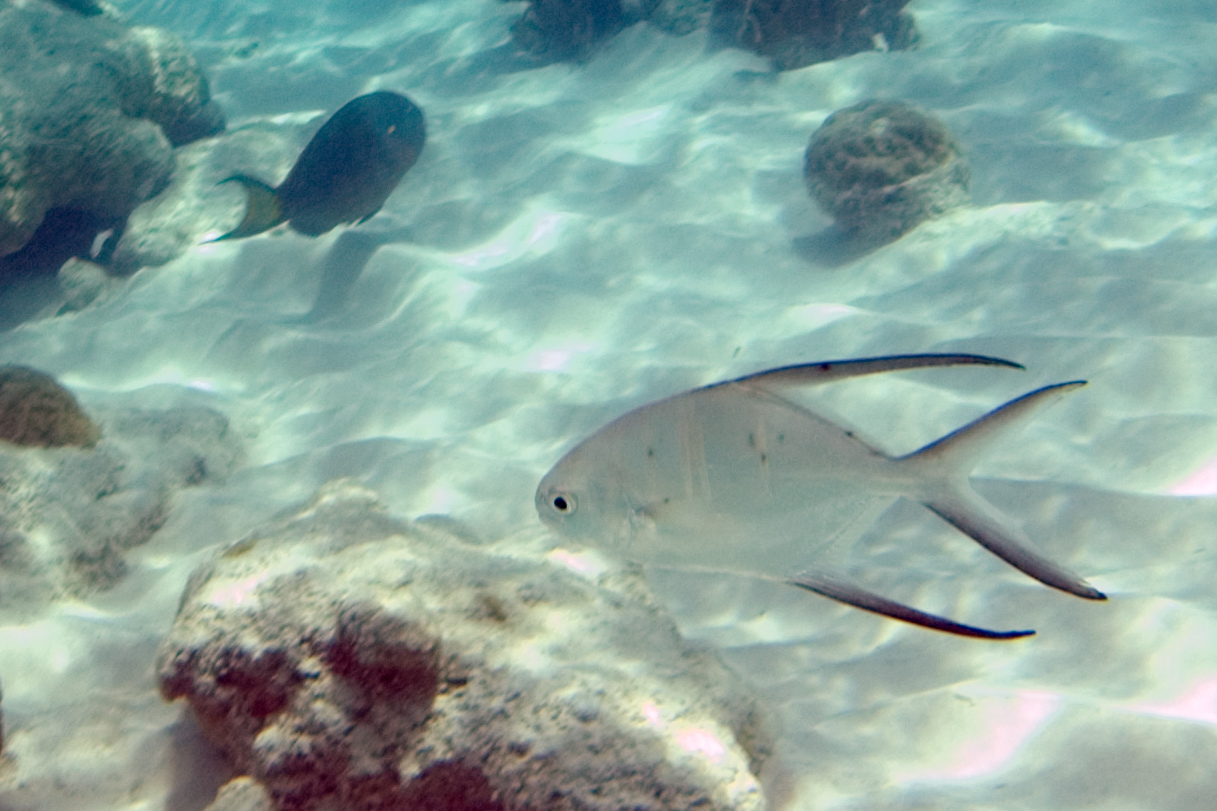
Image by Paul Asman and Jill Lenoble via Wikimedia Commons - Palometa Jack

When you are walking through the sand, you are potentially stirring up tiny organisms like little worms, shrimp, or crabs, which the fish near your feet hope to gobble up.  That is why the silvery palometa jack and other fish are often hanging around near your feet at the beach.  If you want to attract fish, stir up some sand!    

Image by Nathanial Kelley - Great Barracuda
When you are snorkeling or scuba diving and find a fish following you, it may be using you as camouflage so it can hide from potential predators, or to sneak up on potential prey.  It may also be hoping that you (the bigger "fish") catch some prey and they get to feed on the remnants of your meal.  I have had barracuda, Atlantic spade fish, grey angelfish, bar jack, and many other fish species follow me while diving or snorkeling.  Don't worry, despite their menacing teeth, the barracuda have no desire to eat you!

Image by NOAA CCMA Biogeography Team via Wikimedia Commons - Southern Stingray with shadow-feeding Jack


Video by Amy Kelley


Many times you will see a bar jack following along with a stingray.  The bar jack is also shadow feeding, hoping to get an easy meal when the stingray stirs up the sand.  


Image by Peterkoelbl via Wikipedia -  Pilot fish following an oceanic whitetip shark


A fish called a pilot fish often accompanies sharks, rays, or whales in hope of getting some tasty crumbs from the larger creatures meal, or finding ectoparasites they can pick off the larger creature. 


Image by Giorgio Galeotti - Green Sea Turtle with Remora
 
Video by Amy Kelley

Remora often cling onto or follow turtles, sharks, and other bigger creatures to feed off their ectoparasites or catch a free meal when their host feeds.  I've even had remora try to cling onto me!  


Video by Amy Kelley

Next time you are diving or snorkeling and are fortunate enough to have a "buddy" follow you or notice an "odd couple", take a moment to appreciate and observe their behavior.  Now you know what the are really up to!  Fish are much more intelligent than most people give them credit for.