Showing posts with label mask. Show all posts

Wednesday, August 3, 2016

How to be a Good Dive Buddy

Diving with a buddy is more practical, safe, and fun.  © PADI 2016

Dive buddies are great.  They are someone to travel with, someone to explore with, and someone to create new memories with.  They may be your boyfriend or girlfriend, husband or wife, your kid, your mom or dad, your friend, your co-worker, or someone that you just met!  The purpose of a dive buddy is to make your dives more practical, safe, and fun.  But do you know what it takes to be a good dive buddy? 

Practice your buoyancy © PADI 2016

Mask skills should be practiced often - Image by TauchSport_Steininger via Flickr

1. Stay sharp on your own skills so you can help yourself and your buddy 

Make sure you are up to date with all of your dive knowledge and skills.  Just because you are certified does not mean that you don't have to practice.  Read our blog "Skills every diver should practice."  It is also very important to stay fit for diving.


Know your buddy's equipment © PADI 2016

2. Be familiar with your buddy's equipment

Know how to release your buddy's weights in case of an emergency, and be familiar with your buddy's alternate air source in case you need to use it.  If your buddy has an underwater signaling device to get your attention, make sure you know what to listen for.


Image by Vera Kratochville via Public Domain Pictures

3. Don't pressure your buddy into a dive (s)he is not comfortable doing 

Staying within your training and personal limits will help to keep you safe.  Respect your buddy's limits; they may be different than your own.  Emergencies happen much more often when you dive outside of your training or personal limits.
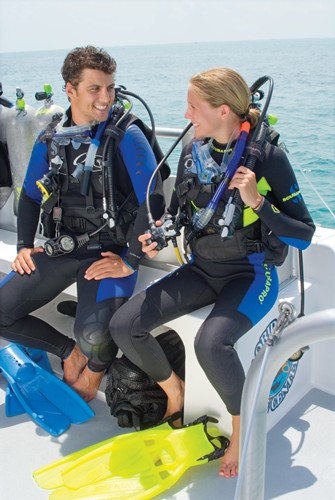

Pre-dive safety check with your buddy © PADI 2016

4. Do a pre-dive safety check with your buddy before every dive 

Practice good habits to prevent accidents before they happen.  Do a buddy check together, remembering BWRAF.

B - BCD (inflate),
W - Weights (do you have them, are they secured properly, and are they balanced?),
R - Releases (all releases clipped and snug),
A - Air (Do you have a full tank, is it fully open, and can you breathe through both of your second stages?),
F - Final check (Do you have your mask, fins, and any accessories you plan to dive with?  Are conditions reasonable?  Are you both feeling up to it?). 

There are some silly sentences that can help you remember what to check.  Here are a few examples, but feel free to be creative and make up your own:

Image by Ross Little via Flickr
Big White Rabbits Are Fluffy

Image by Leonardo Laporte via Public Domain Images
Beans With Rice And Fish

Image by Yuya Salto via Flickr
Burgers With Relish And Fries

Image via Wikipedia
Blonde Women Really Are Fun

Image by Parafly via Pixabay
Brunette Women Really Are Fun

Image by Loren Javier via Flickr
Bruce Willis Ruins All Films

Once you have made the pre-dive safety check into a habit, it will become quick and easy.  I can't even count how many times I've seen even experienced divers jump into the water without doing a pre-dive safety check.  At the least they look like a fool when they hit the water and they forgot something important.  At the worst it can lead to an emergency.

Descending with buddy © PADI 2016

5. Descend with your buddy 

A good buddy stays at the same level with his/her buddy while descending.  Even if your ears are capable of equalizing rapidly, don't rush down to the bottom.  If your buddy has a problem and needs your help you won't be there to help him/her.  While you're sitting on the bottom waiting for your buddy, you're chugging through your air because you consume more air at depth. You are also absorbing more nitrogen at depth, and wasting no-decompression time while your buddy makes his/her descent.

Stay close to your buddy © PADI 2016

6. Stay with your buddy during the dive 

Though you don't have to hold hands during the dive, you should always be within about 10 feet or less (depending on visibility).  This is to avoid buddy separation, and to be readily available for one another in the event of an out of air emergency.  Work on your buoyancy control, though, so you're not constantly running into one another.  It feels very claustrophobic to be constantly colliding with your buddy.  There is no reason to rush on a dive.  The slower you go, the more you usually see.  Don't make your buddy have to struggle to keep up with you.


Share interesting encounters with your buddy © PADI 2016

7. Share the interesting things you find with your buddy 

One of the most fun things about diving is finding interesting fish and creatures.  Make sure your buddy sees what you are looking at so you can share the experience.  There are many hand signals for fish and creatures, and they are fun to learn.  You can make up your own, too!


Alternate Air Source Ascent © PADI 2016

8. Check your buddy's air 

Check your buddy's air from time to time.  It is important to know how much air your buddy has so you can both get back to the boat or to your exit point with at least 500-700psi of air left.  Avoid running out of air, since it puts both of you in unnecessary danger. 


Safety stop with your buddy © PADI 2016

9. Ascend with your buddy 

At the end of your dive, ascend together with your buddy.  You should both get into the habit of doing a 3 minute safety stop at 15 feet before ascending, and ascending slowly from every dive - no faster than 1 foot per second.  Remember to deflate the expanding air from your BCD's as you ascend so you are always in control and never being buoyed up by your BCD.  As soon as your heads touch the surface, make sure you both inflate your BCD's so you are positively buoyant and not in danger of sinking back down.  Grab onto the line behind the boat if you are boat diving so you don't drift away.


Log your dives with your buddy © PADI 2016

10. Log your dives together & talk about them

Every dive can be a learning experience.  Even though you are certified, you are never finished learning.  Was there anything either of you could have done differently?  Did you stick to your dive plan?  How clear was communication with your buddy?  Are there any skills either of you should work on?  Did you see any new fish or creatures?  Talk to your dive guide, grab a book from your local dive shop, or go online to find out what interesting new creatures you saw.  


The ocean is an amazing place, and is best when shared!  Now you know how to be a great buddy!

Dive buddies © PADI 2016


Wednesday, July 13, 2016

Skills Every Diver Should Practice

Image by Ahmad Faiz Mustafa via Wikipedia

How long has it been since you took your scuba certification course?  Months?  Or has it been years?  Many divers become complacent because they have been diving for "so long."  But being a safe diver has nothing to do with how long you have been diving.  The big question is, how sharp are your skills?  Are you comfortable enough that you know you can handle any problem that may occur underwater and confident that nothing will cause you to panic?  Do you remember and understand basic dive theory to keep you safe from injury and decompression sickness?  

Download the ReActivate program and do it anywhere!  ©PADI 2016

If you cannot answer "YES!" with confidence, it's time to consider Re-Activating your certification and doing a refresher course.  PADI's "ReActivate" program is a way for PADI divers to update their skills and knowledge before getting back into the water.  It's quick and easy, and personalized for you.  You download a program that goes over concepts you learned in your scuba training in a prescriptive way, so you can focus on the things you forgot.  You can do it anytime, anywhere!  Contact Aqua Action Divers or your local dive shop to get your code to download your ReActivate program and get started!  You get to keep the program forever so you can review your knowledge and skills again and again! 
 
Refresh your skills with a PADI Instructor ©PADI 2016

After you complete the digital portion of the ReActivate program you can sign up for a refresher course to practice your in-water skills with a PADI instructor.  If you complete both the digital and the in-water portions of the ReActivate course, you get a replacement certification card that says "ReActivated" on it.  Contact Aqua Action Dive Center to schedule your in-water practice time with one of our instructors!

At the absolute minimum, you should review your dive theory and practice your skills in a pool or in calm shallow water.  Here are a few of the skills that you should practice regularly because they are essential to your safety :

Image by TauchSport_Steininger via Wikipedia
No mask breathing - You must be comfortable with water around your face.  It is not uncommon for masks to leak a little bit on a dive.  Although less likely, your mask strap could break or you could lose your mask during a dive.  You must be able to stay cool, calm, and collected and avoid panicking if this were to ever happen to you. 

Image by Peter Southwood via Wikimedia Commons

Cramp release - The muscles you use when you are swimming with fins are muscles you may not use much in your everyday life.  Cramps can happen from dehydration or working a muscle more than you're used to.  Knowing how to deal with cramps in your feet or legs is important to avoid panic during a dive.  You should be able to calmly signal to your buddy, grab your fin tip, and stretch until the muscle has relaxed.

Image by Von Thomei08 via Wikipedia

Dealing with a sticky BCD inflator button - If your BCD inflator button sticks while you are on a dive, it could send you shooting to the surface and put you at great risk of decompression sickness if you do not know what to do.  Be familiar with the dump valves on your BCD so you can dump out excess air from your BCD and prevent a runaway ascent.  Practice disconnecting your low pressure inflator hose while under pressure, too, since it would need to be disconnected if you had a sticky inflator button.  To prevent your inflator button from sticking in the first place, wash your gear well after each use to make sure no salt crystals or sand can cause it to stick.  Also, have your gear serviced annually by a qualified technician.

Image by Mark.murphy via Wikipedia

Emergency weight drop - It is essential to know how to quickly get rid of your weights in an emergency.  For example, if you are on the surface and you cannot keep your head above water and your BCD is not inflating you need to drop your weights to get positively buoyant.  Being familiar with your weight system and knowing how to quickly ditch them can save you from drowning.

Image via Pixabay

Buoyancy control - Poor buoyancy control while diving can lead to ear injuries (read "10 Tips to Prevent Ear Injury"), decompression sickness, lung over-expansion injury, rapid air consumption, hyperventilation, injuries resulting from running into sea urchins or coral, and damaging the reef.  Buoyancy control is the skill that takes the most practice to master, but once you master it your dives will be immeasurably more safe, relaxing, and enjoyable.  

Image by Peter Southwood via Wikipedia

Alternate Air source use  - Although running out of air should never be an issue if you pay attention to your air gauge, it is important to practice using your buddy's alternate air source and having your buddy breathe using your alternate air source.  You should also practice swimming together while sharing air, since it is awkward and does takes team work and coordination.  In the unlikely event that you or your buddy do run out of air from a dive, being able to confidently perform this skill could save you or your buddy's life.

Which of this skills do you feel most confident with?  Are there any of these skills you haven't practiced in a while?  What are you going to do to make sure your skills are sharp before your next dive?  What other skills do you think should be on this list?


Wednesday, June 15, 2016

The Frustration of a Foggy Mask

Image by rkit via Pixabay

Have you ever had a mask that fogged up continuously?  You want to enjoy the beautiful colors of the coral reef, but all you can see is a foggy blur?  You spend more time messing around with your mask on the surface than you do with your face in the water.  You feel jealous at all of the amazing things everyone else keep seeing.  "Did you see that octopus!?"  "Did you see that flounder?"  "Look, a turtle!"  Despite your most noble efforts rinsing the fog out every 10 seconds and squinting your eyes to see past the fog, you don't see anything! 

Image by Petr Kratochvil via Public Domain Pictures Edited by Amy Kelley

Well, stress no more.  With a few tricks of the trade you will be seeing clearly in no time.

You may notice that new masks tend to fog even more than old masks.  Why is this?  When masks are assembled in the factory, a thin film of silicone ends up on the lenses.  That film helps make a water-tight seal between the lenses and the frame of the mask, but it also causes the mask to fog like crazy.   

The coating on the lenses can be removed in a few different ways.  

Image by William Warby via Flickr
  
Toothpaste (the white kind, that is slightly abrasive) can be used to scrub the film off the inside lenses by rubbing it around in a circular motion.  

Image by Christian Carter via YouTube
 
You could also use soft scrub to do the same thing.  

Image by Sun Ladder via Wikipedia

The quickest and easiest way to remove the film is by burning it off.  Carefully take a lighter and move the flame around the inside of the lenses.  It is important that you do not burn the silicone mask skirt or yourself when you do this.  When you notice a black film appearing, you will know that you are burning off the silicone residue.  Let it cool, then wipe away the film with a paper towel or tissue.  You can repeat this process until the black residue is no longer appearing.

After you have removed the silicone film and the lenses have cooled, you can apply a commercial defog solution for best results.  We sell Trident de-fog at the dive shop here in Secret Harbor.  

Image by Stephanie-inlove via Deviant Art

The next best option is using diluted baby shampoo.  Any soap would work, but the "No tears" aspect of baby shampoo makes it better.  As a last resort, if you don't have anything else, spit can also do the trick...but it doesn't work as well or last as long.  The key to using any defog solution is to apply it right before entering the water, and only give it a light rinse so the residue from the defog is still on the lenses.  If the lenses have a slippery coating, any condensation will bead-up and fall down to the bottom of the mask, leaving your view crystal clear.  


Image by OpenClipartVectors via Pixabay

If your skin is significantly warmer than the water temperature, the temperature difference will cause the inside of your mask to condensate more.  

Image by Rudyasho via Wikimedia Commons

To minimize this effect, submerge or splash your face to let your skin cool before putting your mask on.


Happy snorkeling!  I hope your next time out on the water is fog-free and full of amazing fish and creature sightings!

Image by Amy Kelley